

Towards Thanksgiving

Thanks to Kerri for kicking off our double presentation session, and for her thoughtful consideration of the constraints teacher’s face in the current educational climate.

We touched upon the classic Teaching Writing as Process Not Product by Donald Murray.  It was written nearly 50 years ago (can you believe it?) and yet, these ideas still seem to be fresh in certain educational contexts (…which in and of itself is kind of depressing if you ask me). Murray emphasizes writing as “the experience of discovering through language”, and he implores his readers to consider teaching unfinished writing instead of finished writing.  The “unfinishedness” should be embraced, and in order to get there with our students, we should be prepared to shut up and let our students realize this on their own terms while respecting the potential of their own truths and their emerging voice. 

When it comes to writing pedagogy, Wiley ultimately points out the pros and cons of the formulaic nature of Schaffer’s pedagogy (the multi-paragraph essay).  It was interesting to read all of your blog posts because you had very strong feelings about this writing approach. The formula approach is indeed where much creativity gets thwarted.

Perhaps teachers should use the formula approach as a “strategy”, but not a “formula” per se.   “To develop as writers, students must develop a repertoire of strategies for dealing effectively with various writing tasks presented to them in different situations. They must also learn to make choices about genre, content, structure, organization, and style; and they must learn to hone their judgments about the effects of the choices they make as writers.”  It would be preferable if teachers (and school districts) build out “formula” strategies for students (to help some gain confidence), but from there, perhaps they should also decide what more there is to do, once students have a framework for the multi-paragraph academic essay.   And as we discussed, the Schaeffer method won’t work in all contexts/situations, and it shouldn’t.  The method can be deeply discouraging/dismissive to the inherent creativity that some students are blessed with. Once students have learned this strategy (or concurrently as they are learning it) they should also move forward, outward, and onward to genres, audience, critical thinking, and exploration of their own writing.  Think of bike riding – the formula-approach is like training wheels that can eventually come off.  Sometimes this kind of “formula approach” really works in onboarding reluctant writers, giving them just enough confidence to get them “in the game”.  And that is a remarkable outcome, in and of itself. Thanks to Kerri for opening up our thoughts to new assignments and strategies. Those “dream” assignments might link student writing to their creativity and to a personal (self-determined) sense of purpose.

It was perfect to segue from thoughts on “constraints” and writing formula into the readings Theresa chose for us. They shift our focus to ideas like -empowerment, -voice, and -justice. The contrasting concerns in these two selections are a telling juncture for us, when thinking about writing theory and writing practice..

“Writing is my passion. It is a way to experience the ecstatic. The root understanding of the word ecstasy — “to stand outside” — comes to me in those moments when I am immersed so deeply in the act of thinking and writing that everything else, even flesh, falls away.” -bell hooks

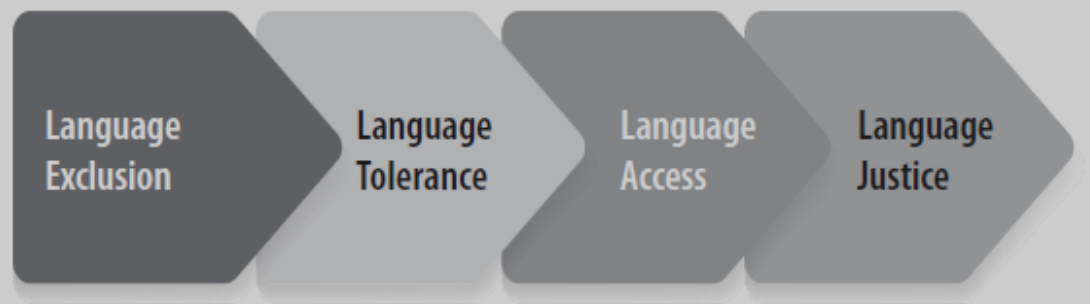
hooks understands writing as a pathway to freedom, and her work on love and equity in the classroom is a critical lens for us, as we build together an understanding of what writing can do for people. Writing is a site of liberation, and yet it can also be a site for containment and compliance. And so the ground we stand on as writing pedagogues is significant, influential, and truly important to our collective future. Moving from bell hooks who centers the importance of voice in self empowerment, to April Baker-Bell’s crucial lens into linguistic violence in schools, we can see the urgent crossroads of language and literacy education – and writing studies in the here and now. Her work reflects on the urgent need for antiracist language pedagogies in our current social and political climate. I especially enjoyed Theresa’s final exercise of design intentions for more equitable classrooms. It was just a small start, but it is indeed the right direction to take our overall conversation. What do we do to open up the world for all voices and perspectives? What does that look like in the spaces we share together?
Your to-do list for 11/22?

–Read for next week Giselle’s selection:  Pedagogy of the Oppressed, by Paulo Freire (Chapter 1)

Blog #9 Due before – Reflection blog post on Giselle’s reading selection

Session 9: Pedagogy of the Oppressed (Chapter 1)

I thoroughly enjoyed reading Paulo Freire’s work this week. Pedagogy of the Oppressed gave me a lot of knowledge and a lot of ideas to “chew on” and work with. In fact, I was underlining and annotating my paper as I read because I found myself that invested in the work, eager to understand as much as possible. Freire’s work, in my opinion, strikes a beautiful balance between being rich in theory and being easily understood, and his pedagogical ideas, I can see, are deeply influential even today.

I find a lot of merit in Freire’s idea that humanization is “the people’s vocation.” I can think of no better goal for humankind than to work toward the freedom and justice of all people, and Freire posits that this very thing is the overarching goal of all humankind, right at the beginning of Chapter 1. We can see right at the start that, more than only a theory about education, Freire’s pedagogy is a sort of philosophy on life and humanity as well.

The main idea of Chapter 1 is the fact that, with the overarching goal of humanity being humanization, the only ones who can work towards and achieve this goal are the oppressed and those who are truly in solidarity with them. The work must be led by the oppressed, and those who wish to work alongside them must, rather than being paternalistic and “looking down” on them/patronizing, trust the oppressed and follow their lead. This is an idea that is echoed today, often expressed in the term of majority groups amplifying the voices of minority groups, not speaking over them or attempting to speak for them. Those in power must give the oppressed a “seat at the table” and allow them to speak for themselves and advocate for themselves, not try and do so for them (which, ultimately, as Freire describes, keeps the current oppressive class system intact, harming the oppressed and benefiting the oppressors.)

Freire posits that, during the initial stages of struggle, the oppressed often strive to become like their oppressor, because that is their model of humanity. The example I had in my head for this was as follows: a poor man strives to become like his boss, because he sees his wealth and control over others as success and he, too, wants to become successful. However, in order to become like his boss, this man too becomes an oppressor, treating those under him poorly and hoarding his wealth because that is the example he saw of a “successful” man. We see cases like this a lot today, however, I think we do recognize it as being wrong; think about the movies you’ve seen or stories you’ve read and heard where the above example is the plot, and where the once-poor man realizes the error of his ways and sees that he has to start treating people better and caring less about his wealth. Despite some kind of internal recognition that greed and the mistreatment of others are wrong, though, people keep doing it. There is still the struggle of wanting to “become” the oppressor, of chasing the mainstream idea of a successful human. This moving of roles, though, from oppressed to oppressor, is not an authentic solution to the problem at hand. Instead, both parties must be liberated, by the hand of the oppressed groups seeking humanity.

Something else that really resonated with me is the idea that even once the issue starts to be authentically resolved, with the oppressed fighting for and gaining their humanity, the former oppressors will start to feel oppressed themselves instead of realizing that both groups are now more liberated. Freire states “conditioned by the experience of oppressing others, any situation other than their former seems to them like oppression. Formerly, they could eat, dress, wear shoes, be educated, travel, and hear Beethoven; while millions did not eat, had no clothes or shoes, neither studied nor traveled, much less
listened to Beethoven. Any restriction on this way of life, in the name of the rights of the community, appears to the former oppressors as a profound violation of their individual rights.” This reminds me of how members of majority groups today complain about minority groups fighting for equal rights. Some straight people will complain that the LGBTQ+ community is “taking over everything,” some white people complain about the Black Lives Matter movement, asking “what about white lives?” These people and others like them miss the point that minority groups have not enjoyed the rights, safety, protections, and freedoms that the majority groups always have. They don’t realize that equal rights are not in finite supply; everyone can and should have them, and everyone should keep fighting until those rights are afforded to all.

There was a part of this chapter that confused me a bit, though I think I may have worked through it. The part is as follows:

The pedagogy of the oppressed, animated by authentic, humanist
(not humanitarian) generosity, presents itself as a pedagogy of
humankind. Pedagogy which begins with the egoistic interests of
the oppressors (an egoism cloaked in the false generosity of paternalism) and makes of the oppressed the objects of its humanitarianism,
itself maintains and embodies oppression. It is an instrument of
dehumanization. This is why, as we affirmed earlier, the pedagogy
of the oppressed cannot be developed or practiced by the oppressors. It would be a contradiction in terms if the oppressors not only
defended but actually implemented a liberating education.

Paulo Freire, Pedagogy of the Oppressed, page 54

I was specifically confused about the last two sentences. Of course, I agreed that the pedagogy could not be developed by oppressors; to be truthful, effective, and humanized, it had to be developed by those who were oppressed. However, I was confused by the notion that oppressors could not practice the pedagogy, either, and that they could not defend or implement a liberating education. Isn’t that the ultimate goal, I asked myself? For mainstream education to make use of this pedagogy in order to start breaking down the walls of oppression? Then I realized…those who are still in an oppressor mindset cannot practically teach a liberating education. In order for one to do so, one has to step out of the role of oppressor and come and work alongside the oppressed, amplifying their voices and following their lead. This, I think, is what Freire meant. It is not that educators who are part of the majority group cannot implement this pedagogy, but rather that they first must be transformed out of their role of the oppressor (even if this transformation requires not a physical change but a mental one) before they can be considered no longer oppressors but allies to the oppressed and therefore appropriately implement a liberating education.

So, these have been (some of!) my thoughts on Pedagogy of the Oppressed. Again, I found the reading extremely insightful and will probably aim to read the rest of the book in my free time, because though I don’t intend to become an educator, I think this is important information to know nonetheless if simply to become a better human being.

Pedagogy of the Oppressed

This was quite the insightful and interesting read of an analysis of the exploration relationship between the colonizer and the colonized. I feel as if though, Paulo Freire does an amazing job in explaining and touching base on the oppressed with his own cultural experience teaching adults in Brazil how to read and write. One insightful contributing thought Paulo Freire mentions is how, pedagogy the “banking model of education.” He elaborates how it treats the student as an empty vessel to be filled with knowledge. Much in comparison to a piggy bank. He further mentions/argues that pedagogy should instead treat the learner as a co-creator of knowledge. Which in a sense, once he broke it down in his writing, I can agree.

The book is broke down into four chapters. What I found also fascinating and clearly went over my head, was that the book was first written in Portuguese. After much success after publication, it was later translated to English. Once again, completely went over my head that a Brazilian author would first write his book in Portuguese, rather than English. Nonetheless, this was a good read.