

Thanks to Kerri for kicking off our double presentation session, and for her thoughtful consideration of the constraints teacher’s face in the current educational climate.
We touched upon the classic Teaching Writing as Process Not Product by Donald Murray. It was written nearly 50 years ago (can you believe it?) and yet, these ideas still seem to be fresh in certain educational contexts (…which in and of itself is kind of depressing if you ask me). Murray emphasizes writing as “the experience of discovering through language”, and he implores his readers to consider teaching unfinished writing instead of finished writing. The “unfinishedness” should be embraced, and in order to get there with our students, we should be prepared to shut up and let our students realize this on their own terms while respecting the potential of their own truths and their emerging voice.

When it comes to writing pedagogy, Wiley ultimately points out the pros and cons of the formulaic nature of Schaffer’s pedagogy (the multi-paragraph essay). It was interesting to read all of your blog posts because you had very strong feelings about this writing approach. The formula approach is indeed where much creativity gets thwarted.

Perhaps teachers should use the formula approach as a “strategy”, but not a “formula” per se. “To develop as writers, students must develop a repertoire of strategies for dealing effectively with various writing tasks presented to them in different situations. They must also learn to make choices about genre, content, structure, organization, and style; and they must learn to hone their judgments about the effects of the choices they make as writers.” It would be preferable if teachers (and school districts) build out “formula” strategies for students (to help some gain confidence), but from there, perhaps they should also decide what more there is to do, once students have a framework for the multi-paragraph academic essay. And as we discussed, the Schaeffer method won’t work in all contexts/situations, and it shouldn’t. The method can be deeply discouraging/dismissive to the inherent creativity that some students are blessed with. Once students have learned this strategy (or concurrently as they are learning it) they should also move forward, outward, and onward to genres, audience, critical thinking, and exploration of their own writing. Think of bike riding – the formula-approach is like training wheels that can eventually come off. Sometimes this kind of “formula approach” really works in onboarding reluctant writers, giving them just enough confidence to get them “in the game”. And that is a remarkable outcome, in and of itself. Thanks to Kerri for opening up our thoughts to new assignments and strategies. Those “dream” assignments might link student writing to their creativity and to a personal (self-determined) sense of purpose.
It was perfect to segue from thoughts on “constraints” and writing formula into the readings Theresa chose for us. They shift our focus to ideas like -empowerment, -voice, and -justice. The contrasting concerns in these two selections are a telling juncture for us, when thinking about writing theory and writing practice..
“Writing is my passion. It is a way to experience the ecstatic. The root understanding of the word ecstasy — “to stand outside” — comes to me in those moments when I am immersed so deeply in the act of thinking and writing that everything else, even flesh, falls away.” -bell hooks
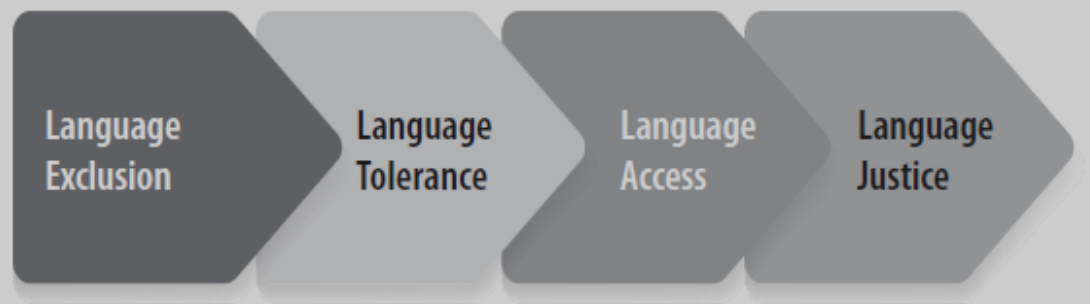
hooks understands writing as a pathway to freedom, and her work on love and equity in the classroom is a critical lens for us, as we build together an understanding of what writing can do for people. Writing is a site of liberation, and yet it can also be a site for containment and compliance. And so the ground we stand on as writing pedagogues is significant, influential, and truly important to our collective future. Moving from bell hooks who centers the importance of voice in self empowerment, to April Baker-Bell’s crucial lens into linguistic violence in schools, we can see the urgent crossroads of language and literacy education – and writing studies in the here and now. Her work reflects on the urgent need for antiracist language pedagogies in our current social and political climate. I especially enjoyed Theresa’s final exercise of design intentions for more equitable classrooms. It was just a small start, but it is indeed the right direction to take our overall conversation. What do we do to open up the world for all voices and perspectives? What does that look like in the spaces we share together?
Your to-do list for 11/22?
–Read for next week Giselle’s selection: Pedagogy of the Oppressed, by Paulo Freire (Chapter 1)
Blog #9 Due before – Reflection blog post on Giselle’s reading selection


